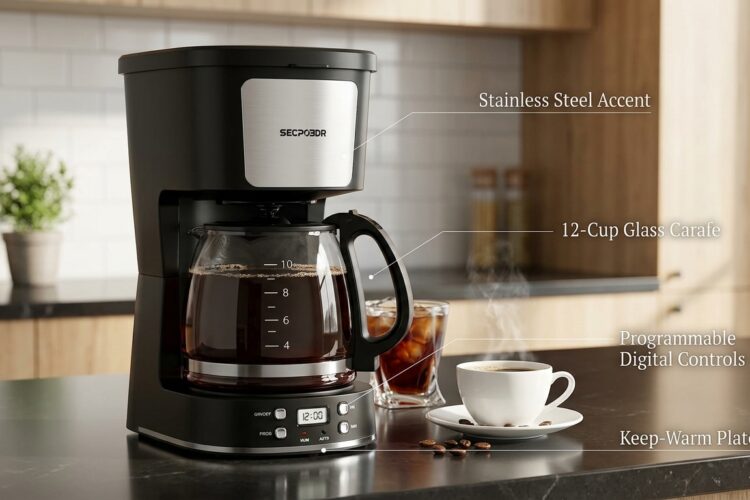
Few appliances earn their counter space as reliably as a drip coffee maker. It doesn’t ask for barista skills or a learning curve, and it can turn a scoop of grounds and some water into a full pot while you’re still looking for a clean mug. The SECPOEDR 12-Cup Programmable Drip Coffee Maker sits in that familiar, practical category. It pairs a timer-based brew function with a warming plate, a removable filter basket, and an LCD display.
This guide walks through what the machine offers, how people might use it day to day, who it tends to suit, and what’s worth thinking about before bringing any drip brewer home. The goal is to give you information, not to nudge you toward a decision.
What Is a Programmable Drip Coffee Maker?
A drip coffee maker heats water and distributes it over ground coffee held in a filter basket. Gravity pulls the water through the grounds, and the brewed coffee collects in a carafe below. It’s among the most common home brewing methods because it’s forgiving, low-effort, and capable of producing several cups at once.
The “programmable” part means you can set the machine to begin brewing at a time you choose. Load it the night before, set the clock, and the coffee is ready when you wake up. For anyone whose mornings are tight, that small bit of automation can matter more than any other feature on the spec sheet.
Key Features
Based on the product listing, here are the main characteristics of this model, described in general terms.
12-Cup Capacity
A 12-cup carafe is a common size for households and small offices. It’s worth remembering that “cup” in coffee-maker terminology usually refers to a smaller measure than a standard mug, often around five ounces. So a 12-cup pot typically yields somewhere in the range of six to eight regular mugs, depending on how large your mugs are. That’s still plenty for a family breakfast or a shared workspace.
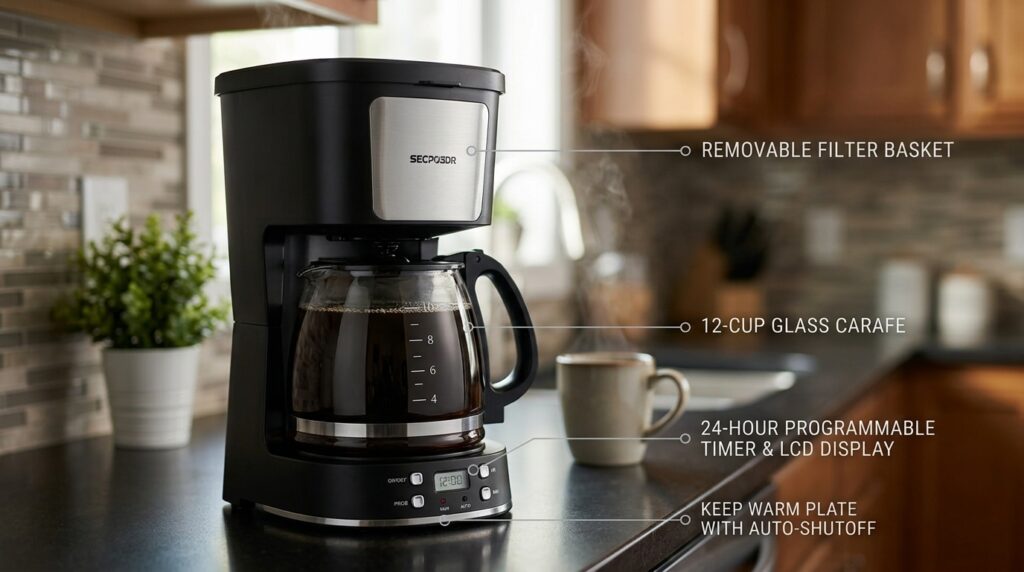
Programmable Timer
The auto-brew function lets you schedule brewing in advance. Rather than standing at the counter at 6:30 a.m., you prepare the machine earlier and let it start on its own. If you’ve ever tried to function before your first cup, you’ll understand the appeal.
LCD Display
A digital display makes it easier to see the current time, set the brew schedule, and confirm settings. Compared with dial-only machines, a screen generally reduces guesswork, particularly during programming.
Keep-Warm Plate
Once brewing finishes, a heated plate under the carafe helps hold the coffee at a drinkable temperature. This is convenient if you tend to drink coffee slowly or if several people pour at different times. As with any warming plate, though, coffee held on heat for an extended stretch can develop a more bitter or cooked flavor, so it’s best treated as a short-term convenience rather than an all-morning solution.
Auto Shut-Off
An automatic shut-off feature turns the heating element off after a set period. This is a practical safety and energy-saving measure, and it offers some reassurance for people who occasionally rush out the door and wonder whether they left the machine running. Check the product manual for the exact timing, since it can differ between models.
Removable Filter Basket
A filter basket that lifts out is easier to rinse and clean than one that’s fixed in place. Since coffee oils and residue build up over time, easy access to the basket is a real maintenance advantage.
Easy-to-Clean Design
The listing highlights simple cleaning as a priority. In general, drip machines with fewer crevices and removable parts are quicker to wipe down and descale, which helps keep flavor consistent over the long run.
How It Can Be Used
A machine like this isn’t limited to a single morning routine. Here are a few ways people commonly put a standard drip brewer to work.
The scheduled morning pot. Measure grounds and water at night, set the timer, and wake up to fresh coffee. This is the most obvious use and arguably the main reason the programmable feature exists.
Hosting and gatherings. When friends or relatives come over, brewing a full carafe is far simpler than making individual cups. A 12-cup capacity can serve a brunch table without much fuss.
Home office or small workplace. A shared pot in a break room or home office keeps a group supplied without needing a larger commercial setup.
Iced coffee preparation. Some people brew a slightly stronger batch, let it cool, and pour it over ice. If you try this, using a bit more coffee than usual can help prevent a watered-down result once the ice melts.
Batch brewing for the week. Coffee can be brewed in the morning and refrigerated for cold drinks later. It won’t taste identical to freshly made coffee, but it’s a handy shortcut for warm afternoons.
A Few Brewing Tips
Regardless of the machine, a handful of habits tend to improve results:
- Start with fresh, cold water. Water quality affects flavor more than many people expect.
- Use the right grind. Medium grind is the usual recommendation for flat-bottom or basket-style drip brewers. Too fine can slow the flow and over-extract; too coarse can leave the coffee weak.
- Measure rather than eyeball. A common starting ratio is about one to two tablespoons of ground coffee per six ounces of water, adjusted to taste.
- Clean regularly. Mineral deposits and oils accumulate, so periodic descaling and washing of removable parts help the machine perform consistently.
Who It May Be Suitable For
No single appliance fits every household, but some groups tend to find this style of brewer a reasonable match.
People who want a straightforward routine. If you prefer pressing a button over mastering pour-over technique, a programmable drip machine matches that mindset.
Families and shared households. With a full-size carafe, several people can pour from one batch, which cuts down on repeat brewing.
Busy professionals and early risers. The timer is the key draw for anyone who wants coffee waiting rather than being made.
Small offices or study groups. A single carafe can keep a handful of people going through a meeting or work session.
First-time coffee machine owners. The learning curve is gentle, and the features are easy to understand without reading much beyond the quick-start guide.
Important Things to Consider
A balanced look at any appliance means thinking about the trade-offs too. Here are some points worth weighing.
Counter Space and Storage
A 12-cup machine isn’t tiny. Measure the space under your cabinets, including the clearance needed to open the lid and slide the carafe out. This is easy to overlook until the machine is already on the counter.
Your Actual Coffee Volume
If you usually drink a single cup, a 12-cup machine may be more than you need. Brewing small amounts in a large machine can sometimes produce less even extraction, and it may feel wasteful. Households with one or two light coffee drinkers might compare it with a smaller capacity brewer or a single-serve option.
Glass Carafe Care
Many drip machines in this category use glass carafes. They’re easy to see through and clean, but they require careful handling, since they can break if dropped or exposed to sudden temperature extremes. Check the product details to confirm the carafe material and any care instructions.
Warming Plate Limitations
As mentioned earlier, a hot plate keeps coffee warm but can alter the taste over time. People who want coffee to stay fresh for hours sometimes prefer pouring leftovers into an insulated thermal container.
Filter Compatibility
Check whether the machine is designed for paper filters, a reusable filter, or both, and what size or shape of filter it requires. Having the right filters on hand avoids a frustrating morning surprise.
Brew Strength and Customization
Basic programmable models typically offer limited control compared with higher-end machines that include adjustable temperature, bloom cycles, or brew-strength settings. If you enjoy fine-tuning your coffee, you may find a simple brewer less flexible. If you value simplicity, that may be a plus.
Product Details and Specifications
Features, dimensions, and included accessories can change, and listings sometimes differ by seller or version. It’s sensible to review the current specifications, warranty information, and manual before deciding.
How It Fits Among General Brewer Categories
Looking at the broader landscape can help clarify what kind of coffee maker suits your needs. There’s no ranking here, only a look at how each type approaches the task.
Standard programmable drip machines (the category this model belongs to) emphasize convenience, batch size, and ease of use. They suit routine-oriented brewing and group servings.
Single-serve pod machines prioritize speed and variety. They brew one cup at a time and reduce cleanup, though they typically rely on proprietary or compatible pods and may generate more packaging waste.
Manual pour-over setups give you the most control over the process and tend to appeal to people who enjoy the ritual. They require more attention and are less practical when making large quantities.
French presses and immersion brewers produce a fuller-bodied cup and are simple mechanically, but they involve manual timing and a bit more cleanup.
Thermal-carafe drip machines work much like standard drip models but replace the warming plate with an insulated carafe, which can keep coffee hot without continued heating. They’re another option for people who sip slowly.
Espresso machines serve a different purpose entirely, creating concentrated shots for lattes and similar drinks. They’re generally more involved and more expensive to operate than basic drip brewers.
Each approach has its strengths. A programmable drip machine tends to make sense when convenience, volume, and a low learning curve are the priorities.
Frequently Asked Questions
How many mugs does a 12-cup coffee maker actually make?
Because coffee-maker “cups” are typically measured at around five ounces, a 12-cup carafe usually fills around six to eight standard mugs, depending on mug size.
Can I set the machine the night before?
Programmable models are designed for exactly that. You add water and grounds, set the start time, and the machine begins brewing automatically. Refer to the manual for step-by-step programming instructions.
Is it safe to leave the coffee maker unattended?
An auto shut-off feature is intended to reduce risk if the machine is left on. Even so, it’s good practice to follow the manufacturer’s safety guidance, keep the machine on a stable, heat-safe surface, and unplug it if you’ll be away for a long period.
How often should I clean it?
Washing removable parts such as the carafe and filter basket after each use is a good habit. Descaling with a coffee-machine-safe solution every month or two, depending on your water hardness, helps prevent mineral buildup.
Will it work with any kind of coffee?
Drip machines generally work best with medium-ground coffee. Whole beans need to be ground first, and very fine espresso-style grounds can clog or over-extract in a basket filter.
Does the warming plate affect taste?
It can, especially over long periods. Many people drink the coffee within an hour or so, or transfer it to an insulated container if they want to keep it hot longer.
Can I make iced coffee with it?
Yes, many people brew a stronger batch and pour it over ice or refrigerate it first. Adjusting the coffee-to-water ratio helps avoid a diluted drink.
What should I check before choosing a drip coffee maker?
Consider capacity, counter space, carafe material, filter type, ease of cleaning, and how much control you want over brewing. Reading the manual and product details helps confirm that the features match your habits.
Final Thoughts
The SECPOEDR 12-Cup Programmable Drip Coffee Maker represents a practical, no-frills approach to home brewing. Its timer, keep-warm plate, auto shut-off, and removable filter basket address the everyday needs of people who want dependable coffee without a lot of steps. Like any appliance, it has limits: it’s not built for fine-tuned brewing, and the size may be more than a solo drinker needs. But for households, shared spaces, or anyone who likes the idea of waking up to a ready pot, this style of machine can be a sensible fit.
The most useful step is to match the features to your own routine: how much coffee you drink, how much space you have, and how involved you want to be in the process. If you’d like to look at current specifications, included accessories, and other details, you can check more details on Amazon here.